
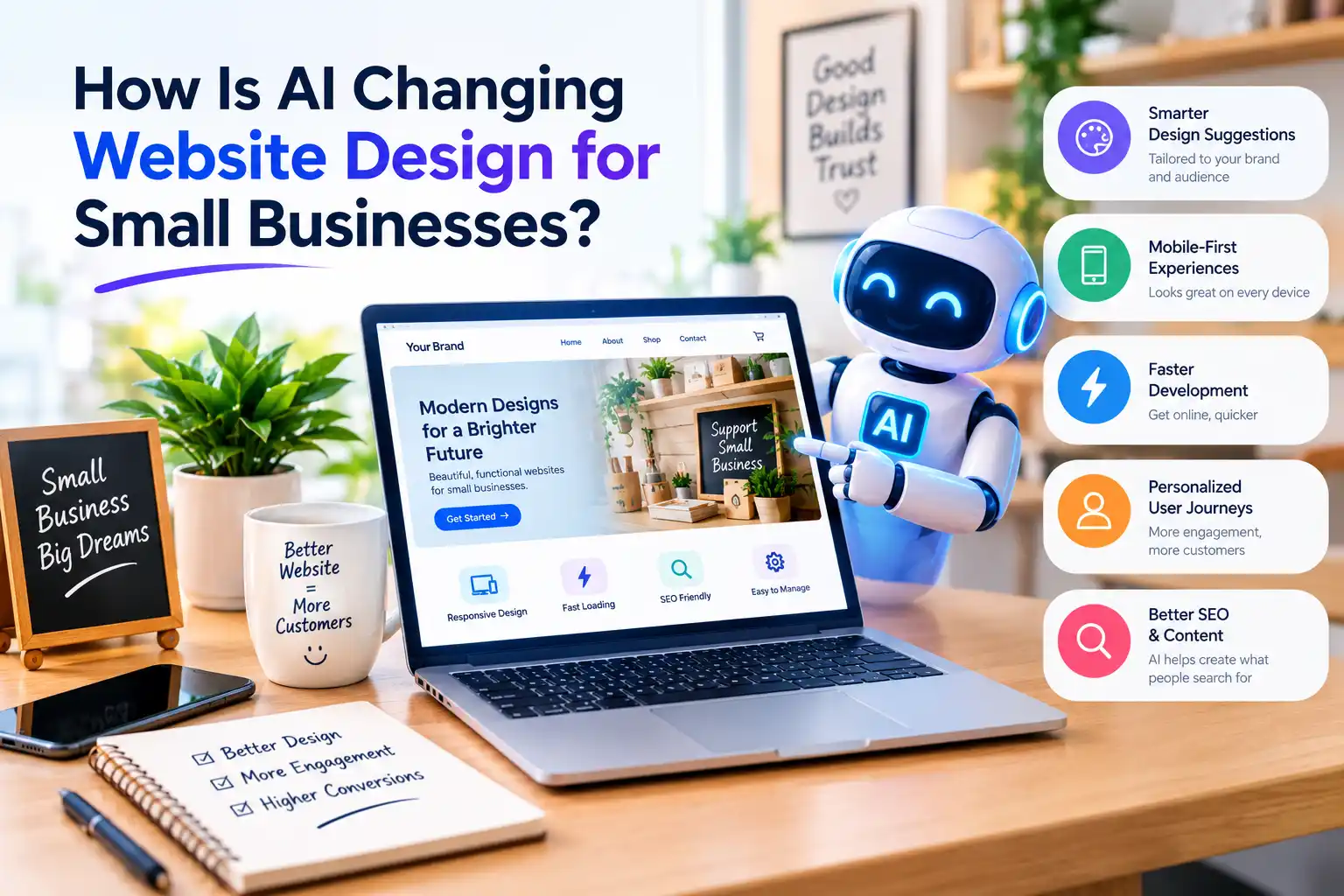
Artificial intelligence is changing how small businesses create, manage, and improve their websites. Tasks that once required extensive time and technical expertise, such as generating website content, personalising user experiences, and analysing visitor behaviour, are becoming easier with AI-powered tools. However, businesses still need a thoughtful strategy to turn these capabilities into real results. A professional Website Designing Company in Vasant Kunj can help small businesses combine AI technology with creative design, usability, and search engine optimisation to build websites that attract visitors and encourage enquiries.
From automated layouts to intelligent chatbots, AI is making website development more accessible. The real opportunity lies in understanding which features are useful, how they affect customers, and when human expertise is necessary to achieve better outcomes.
Traditionally, creating a business website involved planning page layouts, selecting colours, writing content, and configuring technical elements. AI-powered website builders can now assist with several of these tasks by generating initial designs based on a business description, industry, and preferred style.
For example, a local salon can use an AI website builder to create a starting layout featuring service descriptions, appointment buttons, opening hours, and contact information. A consultant can generate a basic professional website without building every section from scratch.
This automation can reduce the time needed to develop an initial website. It also helps business owners explore different layouts before committing to a final design.
However, automatically generated websites are not always ready for publication. Their layouts may look generic, their content may contain inaccurate claims, and their structure may not reflect the business's actual priorities.
Human review remains essential for brand identity, accessibility, mobile responsiveness, and conversion-focused design. AI works best as a productivity tool that supports creative decisions rather than replacing them entirely.
AI is influencing more than the appearance of a website. It can help designers understand user behaviour, identify design weaknesses, and make informed improvements based on available data.
For example, AI-assisted analytics can help businesses identify pages where visitors leave frequently, content that receives little engagement, or sections that may need clearer messaging. Design teams can use these insights to prioritise changes instead of relying entirely on assumptions.
AI-powered tools can also support wireframing, image selection, content organisation, and prototype development. These capabilities allow designers to spend more time refining the customer journey and less time handling repetitive tasks.
When evaluating the Best Web Design Company in Vasant Kunj, small businesses should ask how the provider uses AI in its workflow and whether the technology supports measurable business objectives.
A useful AI-assisted design process should include:
Understanding the business, its target audience, and its goals.
Using AI tools to explore layouts, content ideas, and design possibilities.
Reviewing generated material for accuracy, originality, and brand consistency.
Testing the final website across devices and improving it using performance data.
The objective is not simply to create a website quickly. It is to create an effective digital experience that helps visitors find information, understand services, and take meaningful action.
Modern customers expect websites to provide relevant information without making navigation complicated. AI can help businesses personalise certain aspects of the browsing experience based on visitor behaviour, preferences, or previous interactions.
For instance, an online store may recommend related products based on browsing history. A service provider might display relevant FAQs based on the page a visitor is viewing. A learning platform could suggest courses according to a user's interests.
Such features can make websites more helpful when implemented carefully. They reduce the effort required to find relevant information and can support stronger customer engagement.
Small businesses do not necessarily need expensive, highly complex personalisation systems. Even simple improvements, such as showing relevant service recommendations or making frequently requested information easier to access, can improve usability.
Privacy must remain a priority. Businesses should collect only necessary data, explain relevant data practices, and follow applicable privacy requirements. Personalisation should make the customer experience more convenient rather than intrusive.
Small businesses often have limited staff available to answer customer questions throughout the day. AI chatbots can help address this challenge by responding to common enquiries directly through a website.
A properly configured chatbot can explain services, share business hours, provide basic pricing information, direct visitors to relevant pages, and help customers find contact details. Some systems can also support appointment scheduling or connect users with a human representative.
For example, a local service business may receive repeated questions about availability, service areas, and consultation procedures. A chatbot can handle straightforward questions while allowing staff to focus on more complex requests.
However, chatbots should not be treated as a complete replacement for human support. They may misunderstand unusual questions or provide incorrect information if their knowledge base is poorly maintained.
Businesses should regularly review chatbot responses, provide a clear way to contact a person, and avoid promising capabilities the system cannot deliver.
When implemented responsibly, AI customer support can make a website more interactive and help visitors get answers without waiting for office hours.
Website content plays an important role in explaining services, building trust, and attracting relevant search traffic. AI writing tools can help businesses develop outlines, brainstorm headings, prepare initial drafts, and simplify complicated explanations.
For a small business with limited marketing resources, these tools can make content planning more manageable. They can also help maintain a consistent structure across service pages, product descriptions, and frequently asked questions.
Nevertheless, publishing unedited AI-generated content can create problems. Generic explanations, repeated phrases, inaccurate information, and unsupported claims may reduce credibility and fail to address customers' actual concerns.
Effective website content needs human judgement, industry knowledge, and a clear understanding of search intent. Every page should provide useful information rather than simply repeat keywords.
Businesses investing in Affordable Website Designing in Vasant Kunj should consider content quality alongside design costs. A low-cost website filled with vague or repetitive copy may struggle to persuade visitors, even when its appearance is attractive.
AI should assist with the writing process, while people verify facts, add relevant expertise, and ensure that the final content reflects the business's voice.
A website should evolve as customer expectations and business objectives change. AI-assisted analytics and testing tools can help identify patterns in user behaviour and suggest areas for improvement.
For example, a business may discover that visitors frequently open its service pages but rarely submit enquiry forms. Further investigation might reveal that the forms are too long, the CTA is difficult to find, or visitors need more information before making contact.
AI tools can help analyse such patterns, but their recommendations must be interpreted in context. A high exit rate does not automatically indicate a problem because some visitors leave after finding the information they need.
Useful performance measures include page loading speed, conversion rate, form completion rate, engagement, and the quality of incoming leads.
Businesses can also use controlled experiments, such as comparing two CTA labels or testing different page layouts, to understand which changes improve results.
A data-driven approach helps small businesses focus their limited budgets on improvements that matter rather than making frequent design changes without a clear purpose.
A modern business website should be usable by people with different abilities and across a range of devices. AI-assisted tools can help identify possible accessibility problems, review page structures, and suggest improvements to text clarity.
Some tools can flag missing image descriptions, potential colour contrast issues, or confusing content. Automated checks can provide a useful starting point for reviewing whether a website follows accessibility best practices.
AI can also assist with generating responsive layout suggestions and identifying design inconsistencies across screen sizes.
However, automated tools cannot guarantee that a website is fully accessible. Human testing is still important for keyboard navigation, screen reader compatibility, form usability, and the overall experience of people with disabilities.
Small businesses should treat accessibility as a core design requirement, not an optional feature. A clear, readable, and easy-to-navigate website helps more people access information and complete important tasks.
Although AI tools are becoming easier to use, selecting the right technology and applying it effectively can still be challenging. Small businesses need to consider their budget, website requirements, long-term maintenance, security, and customer expectations.
A suitable Website Design Agency in Vasant Kunj should understand these priorities before recommending automated features or expensive integrations. It should explain which tasks AI can improve, what requires human expertise, and how success will be measured.
Before making a decision, consider these factors:
Business requirements: Identify whether you need a service website, an online store, a booking system, or lead-generation pages.
Technical quality: Check mobile responsiveness, loading speed, security, accessibility, and ease of updating content.
AI functionality: Ask whether proposed tools solve a genuine problem and how their outputs will be reviewed.
Ongoing support: Understand maintenance arrangements, software costs, updates, and technical assistance after launch.
Comparing providers based on these factors is more useful than choosing one simply because it promises the fastest website creation.
For example, Saiway Tech may be considered during the evaluation process, alongside other providers, based on relevant experience, project suitability, and service quality.
AI is transforming website design by making development faster, personalisation more accessible, customer support more responsive, and website optimisation more data-driven. However, successful implementation still depends on sound strategy, human creativity, accurate content, and a strong understanding of customer needs. A Website Designing Company in Vasant Kunj can help small businesses identify practical AI applications while maintaining usability, accessibility, and brand consistency. The best approach is to use AI where it adds genuine value and build a website that supports long-term business growth rather than adopting technology simply because it is available.
1. How does AI help small businesses design websites?
AI can assist with layouts, content drafts, design suggestions, personalisation, and website performance analysis.
2. Can AI build a complete business website?
AI website builders can create an initial website, but human review is important for accuracy, branding, security, and usability.
3. Are AI-designed websites good for SEO?
They can support SEO when they provide useful content, sound technical structure, fast performance, and a positive user experience.
4. Are AI chatbots useful for small businesses?
Yes. They can answer common questions, share service information, and guide visitors towards relevant pages or contact options.
5. Should small businesses replace web designers with AI?
No. AI can automate repetitive tasks, while skilled designers provide strategy, creativity, technical judgement, and customer-focused improvements.
